People say a picture is worth a thousand words. So how much is a video worth? It wasn’t until a few decades ago that images started making an impact on advertising. Picture advertisements in India started as early as 1941 when Leela Chitlis appeared in the first Lux print advertisement. With increasing development in technology, video advertising overtook every other form. Videos in general have the ability to captivate audience, as it generates both images in motion and sound, both of which have an affinity towards the human brain. Here, we will have an elaborate discussion on the use and acceptance of visual content in modern society and how it has changed the world.
Here are 10 reasons why you cannot miss out on videos
- Boost in Conversion and Sales
Videos advertisements have been found to have a bigger impact on the audience than pictures or printed ads. It acts as a bridge between a company and the customers. Video advertisements have an even bigger impact if they include celebrities or personalities that endorse these products. Presence of a video in a company’s landing page can increase the conversions by 80%, and video in a company’s home page can increase conversion by 20%.
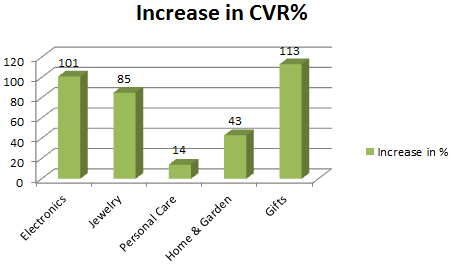
Percentage increase in conversion rate in certain products.
Studies have shown the direct involvement of videos in sales. 4.6 billion video ads are watched every year, with an average individual spending around 16 minutes on ads per month. 55% of the shoppers research products on their phone and 25% say they refer YouTube videos before buying products to check their authenticity and durability. After watching a video, 64% of customers are more likely buy the product online. In conclusion, 92% of the customers say that the visuals of the product is an influential factor in product purchase.
- Enhances Search Engine Optimization [SEO]
A website is evaluated on the basis of the diversity of content available. Google, and other search engines use algorithms to measure the quality of the website. Visual content of good quality helps websites boost their rankings. As per studies, 100 million hours of videos are watched every day on Facebook, whereas, 1 billion hours of video are being streamed on YouTube every day.
A common practice among internet users is that they post their videos on video hosting websites such as YouTube or Vimeo and then embed the video onto their websites. YouTube and Vimeo have a large audience and hence increases traffic on their websites. Similarly, videos are shared on social media platforms where they can be tagged with accounts of users or keywords, boosting their rank on search engines.
- Increases Social Presence
YouTube, since its inception, has been one of internet’s absolute favorites! YouTube personalities have emerged over time. People have made video blogging a profession, and it pays a lot as well. YouTubers, as they are called, get paid according to the views collected on their videos.
To make things clear, let’s talk about the YouTube personality – PewDiePie. Felix Arvid Ulf Kjellberg, as he’s known outside the YouTube realm, is a Swedish gamer. This college dropout created his YouTube account in 2010 when YouTube was just an infant. In 2012, his channel surpassed 1 million subscribers, later pushing it to 5 million in the same year, making him the most subscribed YouTube user. Today, he retains his position and has a net worth of $20 million, a staggering amount that was earned through videos.
- Informing and Educating
Advertisements originated as part of product sales, but they also have the purpose of educating. The customer is likely to be more informed about a product and its qualities through a video advertisement than any other means.
In fact, 97% of marketers insist that videos help the customers in understanding their products in a more elaborate way, leading to hike in sales. In a world of quick online shopping, even a one minute advertisement is enough to educate a person enough to buy a product. Videos help give a closeup look on everything, for the customers.
- High Return on Investment [ROI]
Return on Investment measures the gain or loss generated on an investment relative to the amount of money that is invested. It is one of the frequently used profitability ratios because of its flexibility.
In a survey conducted in early 2017, it was found that 63% of businesses were using video as a major marketing tool. The number went up to 81% in the start of 2018, and now it has reached 87% in 2019.
Video has completely changed the way B2C marketers use to approach customers. By producing brand-centric videos that display creativity and uniqueness, B2C marketers can earn sales by raising awareness for their brand and products. Retail companies have a system where they hand out coupons or tickets or goodies to increase revenue. But B2C businesses go one step ahead by using the data they collect from the person’s social media interests and search history and to tailor advertisements particularly for them. Using the data they get from the internet, only advertisements of interests will be shown. For example, if you’re a regular user of YouTube, and a major part of your search history comprises of music videos, the advertisements that appear will most likely be related to music, say sales for music CDs or tickets for a concert.
2016 saw the rise in the usage of videos on the landing page of websites. It turned out to be a very effective way, with the conversion rate going up to 80%, as mentioned before. As per the Tubular insights survey on B2B marketers, 73% of B2B marketers say that videos positively impact ROI. 96% of B2B companies use video content for marketing. But 32% of the people started using videos as a medium of advertising only in the last 2 years, which questions the acceptance of videos.
Let’s look into the difference that exists between static and video advertisements.
For a static ad, a banner can cost as low as $20 if done by a beginner freelancer. A video ad, however, if produced professionally, can cost a lot with the amount being in thousands of dollars. Equipment, professionals, travel charges add a lot to the expense. In that respect, static advertisements are more convenient as they require images that can be either taken or obtained for free or a low cost. The longer the process of production, the more the people involved have to be paid.
Video ads help people understand better. With just a click, you can explore several topics related to the product, and videos and animated content have a better shot at catching the human eye than static content. With the information they receive through videos, they can decide if they are interested or not. Static ads on the other hand, tend to excel in industries that are highly regulated. Static ads lose their impact over time and have to be replaced sooner.
Brands can incorporate video content for improved ROI by a number of means. They include creating a YouTube channel, posting videos on social media and website, going live on social media like Facebook and Instagram and posting 24 hour snippets called stories on social media.
Case Study : Old Spice
Old Spice is an American brand of male grooming products, started in 1937. Initially, it was shown as an exotic, manly product directed towards older men. It soon started appealing to the younger generation in the 70’s. It had a dull run as it went from a product of luxury to a middle class cologne or aftershave. It was acquired by P&G in 1990. It wasn’t until a spectacular campaign in 2010 that they re-branded. This campaign, titled Smell Like A Man featured a series of humorous ads featuring NFL player Isaiah Mustafa. This changed the target audience from old men to the young generation.

The advertisement gathered over 55 million views on YouTube.
- Helps Build Trust
Videos help build a relationship of trust between the company and the consumer. Video advertisements can be part of campaigns which are a series of related advertisements. These campaigns, like TV shows, get the audience hooked onto the advertisements, making them regular users of the brand. An appropriate example is the Cadbury 5 star ad that used to run between 2005 and 2016. The series of ads that ran for 11 years featured two characters – Ramesh and Suresh, who became so popular that, for a brief point, this product was referred as the “Ramesh-Suresh” chocolate by children. Ramesh and Suresh will go down in the history of video advertising as legends, while Cadbury is still making money out of the sales obtained through this ad campaign.
- Ease of Access
Video advertisements are readily accessible. It may not be possible to search for a static ad such as a poster or a banner for reference, but videos are always one click away. Moreover, companies make sure that the ads are displayed on television enough to attach itself to the viewer’s mind. Apart from this, videos are screened in stadiums, mobile applications, movie theaters and even on the streets. That makes it quite hard for the naked eye to miss.
- Appeals to Smartphone Users
90% of viewers use mobile phones to access videos. YouTube reports that the viewership increases by 100% every year. Almost everyone owns a smartphone and it’s convenient to watch videos on the go. And since the number of smartphone users are growing exponentially, there will only be improvement in results if video advertising is used.
- Product Launch
Videos play a very influential role in the launch of a product or series of products. Often, the first impression is what matters to the audience. If the appeal is not right, the company won’t be treated fairly in the market. Oppo, a Chinese smartphone manufacturer made its way to the Indian market in 2016 with their N1 model. The model was announced to the country with a feel-good romantic advertisement starring Bollywood personalities Sonam Kapoor and Hrithik Roshan, both of whom are prominent in the industry. This, thus helped boost the sales of the product and helped the company lay its foundation in India, therefore leading to the sale of millions of their products.
- Creating Awareness
It’s 2019 and the world is rapidly drifting towards global warming and a possible human extinction if appropriate measures are not taken. National Geographic, an American television network is one of the front runners in taking an initiative to spread awareness and save the world. They do this through their video content. Nat Geo have a huge following, with 74% of the households in USA having access to the network. They produce unpalatable videos that portray reality as it is, and this has affected the masses directly.
Future of Video Content
Videos, without a doubt, are the future of advertising. Technology and its users are only growing in number with time. Instead of printed banners, screens are set up on the streets in several places where advertisements are displayed. This will soon spread to all parts of the world with the accessibility of technology.
As for the future of videos, there’s always space for a creative, emotionally charged advertisement. The internet is a growing phenomenon and so is the people’s understanding of it. The advance of carbon fibers and high speed internet cancels out the time taken to load videos. Internet rates are falling and in India, almost everyone has access to internet because of cheap tariffs on data started by Jio, and the internet quality will only improve as we drift towards the future.

 Adarsh's Work Samples